


Why Is the Whale Festival Not What It Used to Be and how can we improve it?
At every end of September and October, the Hermanus Whale Festival returns to the cliffs and streets of town. It still brings crowds, markets, and music—but ask a long-time resident or repeat visitor, and they’ll likely say the same thing: “It’s not what it used to be.”
What changed? The festival that once celebrated marine life and community spirit now faces questions about crowding, over-commercialization, and a loss of focus. Let’s unpack the reasons behind this shift and ask what the path forward might look like.
When is the Whale Festival this Year 2025
The Hermanus Whale Festival will take place from 3 to 5 October 2025.
This world-renowned event is traditionally held at the end of September or the beginning of October, drawing more than 130,000 visitors to Hermanus each year for a week of festivities celebrating the return of the southern right whales.
A Festival Built on Simplicity
In its earlier years, the Whale Festival felt intimate and distinctly local. The primary goal was simple: to honour the southern right whales that visit Walker Bay each spring.
Highlights included:
- Marine exhibitions by local conservation organisations
- Talks by scientists and marine biologists
- Community theatre, school choirs, and homegrown musicians
- Authentic crafters and food stalls run by locals
There was space to walk, to watch, to listen. And the whales were at the heart of it all. You could spot them breaching while listening to a live saxophone player on the cliff path. The festival wasn’t just an event; it was an experience.

Whale Festival Not What It Used to Be
A Victim of Its Own Success?
Over the years, the festival grew – and with growth came changes.
From 2015 onward, attendance surged, with estimates ranging from 100,000 to 160,000 visitors in some years. Hotels filled up. Restaurants overflowed. Roads gridlocked. By 2019, local authorities reported more than 30,000 cars entering Hermanus over a single weekend.
To some, this was a triumph. To others, it was the beginning of a disconnect between the festival’s original identity and its current form.
Many locals and return visitors describe a loss of intimacy. Stalls began to feel more commercial. Prices increased. Music stages got bigger—and louder. And while the whales still came, they often took second place to shopping and entertainment.
Economic Pressures and Changing Priorities
Running a large-scale festival isn’t cheap. Infrastructure, permits, security, medical personnel, insurance, and marketing all cost money. Sponsorship became necessary. And with big-name sponsors came bigger expectations.
Stall prices also rose. Some local artisans and food vendors were priced out. One long-time vendor shared: “We used to pay a few hundred rand for a weekend stall. Now it’s a few thousand—and the foot traffic doesn’t always translate into actual sales.”
This economic pressure also shifted the planning dynamic. Festival organisers had to focus on high-volume events and stalls to cover rising costs, which naturally pushed out some of the lower-margin but community-oriented aspects that once defined the festival.
When the Weather Turns—and the Festival Doesn’t
In September 2023, a devastating storm caused massive flooding across Hermanus. With municipal water supplies disrupted, organisers were forced to cancel the Whale Festival just days before it was scheduled to begin.
For many residents, this was a wake-up call—not just about the vulnerability of outdoor events, but about the fragility of Hermanus’s infrastructure under pressure. It sparked renewed questions: Should the festival be smaller? More local? Less dependent on numbers?
In the eyes of some, nature was reminding the town of its place—and its purpose.
What the Organisers Say
We reached out to a former festival volunteer and someone close to past planning committees.
Q: Has the festival lost its way?
A: “Not lost, but redirected. As attendance grew, we had to cater to broader audiences. We tried to keep the marine focus but added music, food trucks, and entertainment to meet public expectations.”
Q: Are the whales still central to the event?
A: “In intention, yes. But in practice, it’s been diluted. That’s something we’re actively working on—bringing back guided whale walks, talks, and marine science activities.”
Q: What needs to change?
A: “We need to find balance again. Less focus on volume, more on value. The whales are the stars, not the sideshow.”
Business Owners: Then and Now
We spoke with several local businesses who have experienced the Whale Festival before and after its commercial expansion.
- Café owner in the CBD: “Years ago, festival weekend was our best weekend of the year. People came to enjoy the whales and linger. These days, people rush in, grab something, and move on. It’s chaotic.”
- Artisan chocolatier: “I stopped setting up a stall three years ago. The overheads were too high, and I wasn’t making a profit. It’s become a space for mass-produced items more than handmade goods.”
- Guesthouse manager: “We’re still fully booked every September and October, so the economic engine is working. But I get more complaints about noise, queues, and traffic now. The overall experience has changed.”
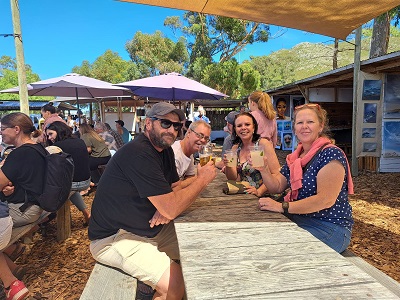
Whale Festival Not What It Used to Be
Some businesses thrive in the new version of the festival; others have opted out entirely.
What Locals Are Saying
Local forums and social media threads offer a wide range of opinions:
- “It used to be about whales, now it’s about food trucks and ticketed music shows.”
- “Why are there barely any quiet spaces to actually watch the whales anymore?”
- “The crowds are overwhelming. I avoid town that weekend.”
- “Still great for bringing money in. But something got lost along the way.”
Not all feedback is negative. Many visitors still see the festival as a unique and worthwhile event, especially families with children and first-time tourists. But among long-time locals, nostalgia runs deep—and often carries a critical edge.
Can the Festival Change Course?
The 2024 Whale Festival is already in planning. Organisers have signaled their intent to reintroduce some of the original features—marine education tents, local art showcases, and family-friendly events focused on nature.
Several ideas have been floated in community meetings and local forums:
- Limit the number of market stalls and prioritise local producers
- Restore educational programming as the centrepiece of the event
- Create quieter zones along the cliff path specifically for whale watching
- Offer lower-cost or free participation tiers for community groups
- Improve public transport or shuttle systems to ease congestion
There’s an opportunity here to rebuild the festival not just in terms of logistics, but in terms of meaning.
What Made It Special
At its best, the Whale Festival reminded people of their place in a coastal ecosystem that still functions—barely—in harmony with wild giants. It brought children face to face with marine biology, not just with carnival rides. It connected artisans with the public, not just vendors with footfall.
In recent years, the festival has struggled to maintain that spirit. But the path back is clear—and perhaps even necessary.
Tourism has changed. Expectations have changed. But whales have not. They return, season after season, without fanfare. Perhaps the festival needs to follow their example—less noise, more presence.
Final Thoughts
The Whale Festival doesn’t need to be what it was. But it must decide what it wants to become.
Will it chase volume and revenue? Or will it rediscover the quieter power of shared knowledge, local creativity, and deep ecological connection?
For many in Hermanus, that answer will shape whether the festival remains something to avoid—or something to look forward to again.
Whale Festival Not What It Used to Be