


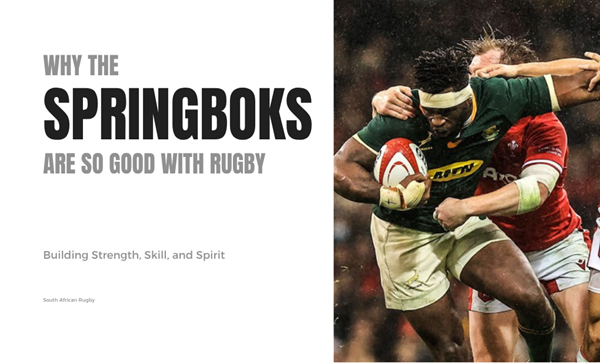
Why are the South African Springboks so good with rugby – 10 Reasons Why
South Africa’s success comes from a deep rugby culture, elite school and provincial systems, tactical innovation, physical dominance, and a strong winning mentality. The country’s passion for the sport ensures a constant flow of talented players.
1. The Historical Roots of Rugby in South Africa
Rugby was introduced to South Africa by British colonists in the late 19th century and quickly took hold, especially among Afrikaner communities. Over generations, it became more than just a game—it grew into a national passion. During the apartheid era, rugby was associated with the white minority, but the 1995 Rugby World Cup marked a turning point. When Nelson Mandela lifted the Webb Ellis Cup alongside captain Francois Pienaar, rugby became a unifying force for a divided nation. This historic moment turned the sport into an enduring symbol of hope and national pride, inspiring countless young athletes to dream of wearing the green and gold jersey.
2. Rugby as Part of the National DNA
Rugby in South Africa isn’t just played; it’s lived. From school playgrounds to rural townships, the sport is ingrained in the culture. Generations of families gather on weekends to support local teams, and entire towns rally behind provincial franchises. For many South Africans, representing the Springboks is not just an athletic goal—it’s a national calling. This deep emotional connection creates an unmatched level of passion and commitment among players and supporters alike.

3. The Power of the School Rugby System
South Africa’s school rugby programmes are the envy of the world. Elite institutions such as Grey College (Bloemfontein), Paarl Gimnasium, Paul Roos Gymnasium (Stellenbosch), Bishops (Cape Town), and Affies (Pretoria) have built reputations as rugby factories. These schools boast exceptional coaching, rigorous training schedules, and state-of-the-art facilities. Young players learn the fundamentals of the game, from set-piece execution to tactical awareness, at an early age. Many future Springboks captained their school’s first XV, and their journeys often start long before they turn professional.
4. The Provincial and Franchise Pathway
After school, talented players advance into provincial academies and professional teams such as the Bulls, Sharks, Stormers, and Lions. This domestic system, bolstered by the Currie Cup and the United Rugby Championship, exposes young athletes to high-intensity competition. Players are developed systematically, moving from youth rugby to professional squads, ensuring a steady supply of elite-level talent to the national team. The competition between provinces creates an environment where only the best thrive, and the Springboks reap the benefits.
5. Physicality: Built for Dominance
South African rugby has long been synonymous with physicality. The Springboks pride themselves on imposing forward packs, dominant scrums, powerful mauls, and uncompromising defence. Many players possess extraordinary size and strength, combined with elite conditioning. This physical profile is complemented by technical mastery, enabling the Boks to dictate the pace and structure of games. Their ability to outmuscle opponents in the contact area remains a defining characteristic of South African rugby.
6. Tactical Evolution and Coaching Innovation
Modern South African rugby is not just about brute force; it is underpinned by tactical ingenuity. Under the leadership of Rassie Erasmus and head coach Jacques Nienaber, the Springboks have embraced new strategies, such as the “Bomb Squad” concept—deploying a bench stacked with forwards to dominate the latter stages of games. The coaching team is known for its meticulous attention to detail, creative set-piece variations, and adaptive game plans. This willingness to innovate keeps South Africa ahead of rivals and maximises their unique strengths.
7. Mental Toughness and Big-Match Temperament
The Springboks are renowned for their composure under pressure. Time and again, they have risen to the occasion in high-stakes matches, whether it’s a World Cup final, a Rugby Championship decider, or a Lions Series clash. This mental fortitude is cultivated through years of competitive rugby at school and provincial levels. Many players come from challenging backgrounds, where resilience and determination were forged long before they stepped onto the international stage.
8. A Culture of Unity and Transformation
Perhaps no other rugby nation embodies unity like the Springboks. Led by captain Siya Kolisi, the first Black Springbok captain, the team reflects South Africa’s diverse population. The players embrace inclusivity and mutual respect, forging a strong sense of brotherhood. Transformation policies have widened the talent pool, giving more players from historically disadvantaged communities the chance to compete at the highest level. This inclusivity has made the team stronger, both on and off the field.
9. Success Across All Levels: The Junior Springboks
The dominance of the Springboks at senior level is mirrored by the Junior Springboks, who are the reigning Under-20 World Champions. Their triumph demonstrates the strength of the country’s development system. Young players are being taught the same values, skills, and tactical principles that drive the senior team’s success. This ensures a seamless transition as the next generation of players steps up to the international stage.
10. South Africa are 4 times World Cup Winners
South Africa’s dominance in rugby is no accident. Through a potent blend of history, culture, infrastructure, innovation, athleticism, and identity, the Springboks have built a powerhouse that’s reshaping global rugby. Here’s an in-depth look at why they’re four-time Rugby World Cup champions (1995, 2007, 2019, 2023—back‑to‑back in ’19 and ’23) and the current squad makeup.

Why South Africa Excels in Rugby
1. Rich History and National Identity
Rugby in South Africa is woven into the national fabric. From the early days of British colonial influence, the sport rapidly became a dominant pastime. Post-apartheid, the Springboks evolved from a symbol of division to one of unity, anchored by iconic moments like the 1995 World Cup victory. That win, featuring President Mandela and captain Francois Pienaar, became a turning point in the nation’s healing process, elevating the sport far beyond mere competition TIME
2. Deep Institutional Infrastructure
- Elite Schools Programmes – Schools such as Grey College and Paarl Gimnasium have produced countless Springboks over decades, serving as a reliable talent pipeline Wikipedia.
- Provincial and Super Rugby Workbench – Domestic competitions (Currie Cup, United Rugby Championship) and franchise pathways (e.g., Bulls, Sharks, Stormers) consistently develop technically proficient, test-ready athletes.
3. Innovation in Coaching and Tactics
- Rassie Erasmus’s Leadership – Since 2018, Erasmus has pioneered innovative strategies—like hybrid roles and unconventional playing mauls—that deliver an edge within the laws of the game RankerReuters.
- Position Adaptability – Players like Andre Esterhuizen switching between center and flanker epitomize tactical versatility Oblasia+13Reuters+13Ranker+13.
4. Physicality Meets Precision
South African rugby thrives on dominance: incredible scrummaging, crushing mauls, vicious defense, and disciplined game control. They’re consistently among the world’s toughest physical sides.
5. Culture and Team Ethos
Captain Siya Kolisi’s inclusive leadership fostered transformational change within the team. Emphasising trust, vulnerability, and shared responsibility, the revamped squad reflects modern South Africa’s unity through diversity The Times.
6. Flow-Through Success at Junior Levels
The under-20 Springboks added another title to South Africa’s trophy cabinet by winning the 2025 U20 World Championship—exemplifying the country’s seamless move-forward development pipeline.
II. Springboks: Four-Time World Champions
Echoing their status as a rugby juggernaut, the Springboks claimed victory in the Rugby World Cup on four occasions—1995, 2007, 2019, and 2023. They also stand among the few teams to ever successfully defend their crown Facebook.
III. Breakdown of Key Current Players
Here’s a snapshot overview of star players in the current (mid‑2025) Springbok squad, highlighting birthplace, age, marital status (where publicly known), schooling, and higher education:
1. Eben Etzebeth – Lock
- Born: 29 October 1991, Cape Town, Western Cape (Cape Province)
- Age: 33
- Marital Status: Married; one child
- School: Hoërskool Tygerberg
- University: University of Cape Town
With over 130 caps, Etzebeth is the Springboks’ most-capped player and a cornerstone of their physical forward play.
2. Damian de Allende – Centre/Wing
- Born: 25 November 1991, Cape Town, Western Cape
- Age: 33
- Marital Status: Not publicly listed
- School: Milnerton High School
- University: University of Cape Town
A creative backline thinker and dual World Cup champion, De Allende blends sharp decision-making with strong carry lines.
3. Handré Pollard – Fly‑half / Inside‑Centre
- Born: 11 March 1994, Somerset West, Western Cape
- Age: 31
- Marital Status: Married (to Marise); they have a son k
- School: Paarl Gimnasium
- University: University of Pretoria Wikipedia
A two-time world champion, Pollard’s composure under pressure and key goal-kicking were crucial to recent title runs.
4. Siya Kolisi – Flanker and Captain
- Born: 16 June 1991, Zwide, Port Elizabeth, Eastern Cape
- Age: 34
- Marital Status: Married; father of two (private family life)
- School: Grey High School, Port Elizabeth
- University: No formal university degree—his rise to captain came through provincial pathways
Kolisi made history as the first Black Springbok captain. His leadership transcends the pitch, both culturally and institutionally.
5. Makazole Mapimpi – Wing
- Born: 1992, Mthatha, Eastern Cape
- Age: 32–33
- Marital Status: Private
- School: Tsholomnqa High School
- University: No formal tertiary education; he matured through regional squad systems
Renowned for his pace, aerial skill and impact off the bench or in starting lineups.
6. Malcolm Marx – Hooker
- Born: 1994, Secunda, Mpumalanga
- Age: 30–31
- Marital Status: Private
- School: Afrikaanse Hoër Seunskool (Affies), Pretoria
- University: University of Pretoria (studied sports management)
A modern hooker known for dynamic ball-carrying and accurate line-out throwing under big-match pressure.
IV. What Makes Them Exceptional
- Development Pathways – Players consistently move from elite schools to provincial squads, Super Rugby teams, and then the national squad.
- Physicality + Skill – Blending brute power with technical expertise, South Africa’s forwards dominate, while their backs deliver precision.
- Tactical Evolution – Erasmus’ hybrid, role-flexible approach challenges traditional structures and keeps opponents guessing.
- Team Transformation and Culture – The Kolisi model places culture at the heart, ensuring purpose, inclusivity, and performance reinforcement.
- Winning Mentality – With back-to-back World Cup victories and junior success, a victory culture is deeply embedded.
Why are the South Africans so good with Rugby
South Africans excel at rugby because of a unique combination of history, culture, infrastructure, and playing style that few other nations can match. Here are the key reasons:
1. Deep cultural roots
Rugby is part of South Africa’s national identity. It’s played in schools across the country, with strong community support and a history of producing players from diverse backgrounds. Winning the 1995 Rugby World Cup turned the sport into a symbol of unity, which continues to inspire young players.
2. Elite school and youth systems
Schools like Grey College, Paarl Gimnasium, and Paul Roos Gymnasium have world-class rugby programmes. Talented players progress from school to provincial academies and Super Rugby franchises, ensuring a constant stream of test‑ready athletes.
3. Physicality and athletic profile
South African players are renowned for their physical power, size, and conditioning. They dominate scrums, lineouts, and contact situations, which remain critical in test rugby.
4. Coaching and innovation
Under directors like Rassie Erasmus, South Africa has embraced tactical flexibility—such as forward-heavy benches, hybrid player roles, and creative defensive systems—that often surprise opponents.
5. Mental toughness and big‑match temperament
The Springboks thrive in high-pressure games, showing resilience and composure. This comes from playing in highly competitive domestic competitions and facing adversity as part of their rugby journey.
6. Transformation and inclusivity
A broader talent pool, including players from historically disadvantaged communities, has strengthened the team. Siya Kolisi’s captaincy embodies this inclusive culture.
7. Winning culture across levels
Success at the under‑20 level—where the Junior Springboks are current world champions—demonstrates that the pipeline is working, producing players who know how to win from a young age.
FAQs About South African Rugby
Why is South Africa so good at rugby?
South Africa’s success comes from a deep rugby culture, elite school and provincial systems, tactical innovation, physical dominance, and a strong winning mentality. The country’s passion for the sport ensures a constant flow of talented players.
How many Rugby World Cups has South Africa won?
The Springboks have won the Rugby World Cup four times: in 1995, 2007, 2019, and 2023, making them one of the most successful teams in the tournament’s history.
Who is the captain of the Springboks?
Siya Kolisi currently captains the Springboks. He made history in 2018 as the first Black player to lead South Africa and has since lifted two Rugby World Cups.
Are the Junior Springboks also successful?
Yes, the Junior Springboks, South Africa’s Under‑20 team, are the reigning World Rugby U20 Champions, proving the strength of the country’s rugby development system.
What makes Springbok players different?
Springbok players are known for their physicality, mental toughness, and technical excellence. Many come from renowned rugby schools and face intense competition from a young age, building resilience and discipline.
Who are some key Springbok players?
Notable players include Siya Kolisi, Eben Etzebeth, Handré Pollard, Malcolm Marx, and Makazole Mapimpi, each contributing unique strengths to the team’s success.
How does South Africa develop rugby talent?
Rugby development begins at school level, with top programmes feeding into provincial academies and professional teams. This structured pathway ensures a steady pipeline of elite players for the national team.
Will South Africa continue to dominate world rugby?
Given the country’s talent depth, strong coaching structures, and winning culture, South Africa is expected to remain a major force in world rugby for years to come.
Why the Springboks Rule World Rugby
10 Secrets Behind Springbok Rugby Success
What Makes the Springboks Unstoppable
Springbok Rugby: 10 Winning Factors
The Springbok Formula for Rugby Dominance
Why South Africa Leads in World Rugby
Springboks: 10 Keys to Rugby Greatness
Inside the Springboks’ Rugby Power
10 Reasons South Africa Owns Rugby
Springbok Rugby: The Winning Edge